

A fan coil unit (FCU) has two water pipes: one supply pipe and one return pipe.
But what many people don’t know is that the position of these two pipes can directly affect how well the FCU cools or heats, how efficiently it operates, and even whether moisture may be carried into the room during cooling.
For many fan coil units, the supply pipe is connected at the bottom and the return pipe at the top. Reversing the connections may significantly affect performance.
Note: The correct water flow direction depends on the coil design. While many FCUs use bottom supply and top return, always follow the supply and return connection markings and the manufacturer’s installation instructions.
Why can such a small installation detail make such a big difference? Let’s take a closer look at the principles. By the end, you’ll know what to check and how to avoid common installation problems.
1. What Does “Bottom Supply, Top Return” Mean?
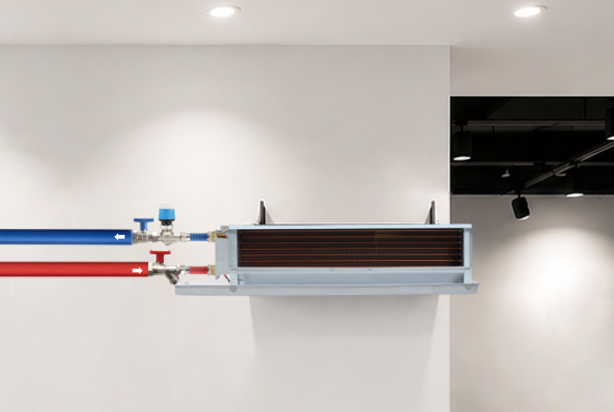
A fan coil unit is the “small air conditioner” at the terminal end of a central HVAC system, often installed inside a ceiling.
Inside the FCU is a coil made of copper tubes and aluminum fins. Chilled or hot water flows through the coil, while the fan blows indoor air across the coil to cool or heat the air.
- Supply pipe: Carries chilled or hot water into the coil.
- Return pipe: Carries the water back to the HVAC system after heat exchange.
- Bottom supply, top return: The supply pipe is connected to the lower connection of the coil, while the return pipe is connected to the upper connection.
In this arrangement, water flows through the coil from bottom to top.
The opposite arrangement, top supply and bottom return, means that water flows from top to bottom.
It may sound like the only difference is the flow direction, so why can the effect be so different? There are three main reasons.
Reason 1: Air Removal and Reduced Risk of Air Lock
Air is inevitably present in a hydronic system. It can enter during initial filling, be released from dissolved air during operation, or enter with make-up water.
Air is lighter than water, so it naturally tends to rise inside the piping.
With bottom supply and top return:
Water flows upward, while air also moves upward. The water and air therefore move in the same direction.
Air can naturally gather at the top of the coil and be discharged through the air vent. This helps minimize air accumulation inside the coil.
With top supply and bottom return:
Water flows downward, while air moves upward. The water and air therefore move in opposite directions.
Air may become trapped at the top of the coil and gradually form an air lock.
When air accumulates inside the coil, part of the coil may not receive sufficient water flow, reducing the effective heat-transfer area.
The result can be reduced cooling or heating performance. The FCU may run for a long time, but the room temperature may still not drop or rise as expected.
Many people may assume that the main HVAC system is undersized, when the actual problem may simply be an incorrect pipe connection that has caused air accumulation.
Reason 2: More Even Heat Transfer and Better Efficiency
In addition to helping with air removal, bottom supply and top return can help achieve more effective heat transfer.
Water enters the coil from the bottom and flows upward through the copper tubes. Each section of the coil can receive water flow, allowing the available heat-transfer surface to be used effectively.
If the flow direction is reversed, the water distribution inside the coil may be less favorable for certain coil circuit designs. Some areas may receive more flow while others receive less, resulting in less uniform heat transfer and potentially lower overall efficiency.
From a thermal perspective, bottom supply and top return can also provide a favorable temperature gradient.
During cooling:
Chilled water at around 7°C typically enters from the bottom. After absorbing heat, the water temperature gradually rises and may reach around 12°C at the outlet.
The chilled water first passes through the lower part of the coil and gradually warms as it moves upward, creating a favorable temperature difference between the water and the air passing across the coil.
During heating:
Hot water enters from the bottom. As it releases heat to the indoor air, its temperature gradually decreases before leaving through the upper connection.
This can also help maintain an effective temperature difference for heat transfer.
Reason 3: Helps Prevent Condensate from Being Blown into the Room During Cooling
During cooling, the coil surface temperature is low, and moisture in the air can condense on the fins.
With bottom supply and top return:
Chilled water enters from the bottom, so the lower part of the coil is generally colder. Condensate forms in the lower part and can flow downward into the drain pan.
The condensate can therefore be collected and discharged more smoothly.
With top supply and bottom return:
Chilled water enters from the top, so the upper part of the coil may be colder. Condensate forms higher on the coil.
As the water droplets flow downward along the fins, the fan behind the coil is also blowing air. As the airflow passes through the fins, it may carry some water droplets and moisture into the room.
As a result, indoor humidity may increase and comfort may be affected.
This does not mean that reversed connections will always cause condensate carryover, but they may increase the risk under certain operating conditions.
2. What Happens If the Connections Are Reversed?
In the short term, the FCU may not show any obvious problems. However, during long-term operation, some issues may gradually become noticeable if the flow direction does not match the coil’s designed connection arrangement.
Reduced Performance
Air accumulation can reduce the effective heat-transfer area, while unfavorable water distribution may also affect heat-transfer performance.
The result may be insufficient cooling in summer or insufficient heating in winter.
Higher Energy Consumption
To reach the desired room temperature, the system may need to operate for longer periods.
As a result, energy consumption may increase.
Higher Indoor Humidity
During cooling, reversed connections may increase the risk of condensate being carried into the room under certain conditions.
This can increase indoor humidity and make the room feel uncomfortable.
Increased Noise
If air remains trapped inside the hydronic circuit, water flowing through the pipes may produce gurgling or bubbling sounds, which can be particularly noticeable at night.
Therefore, incorrect pipe connections are not simply a minor installation detail. They can affect performance, energy consumption, comfort, and operating noise.
3. How Can You Check Whether Your FCU Is Connected Correctly?
If your FCU has already been installed, you can use these simple methods to make an initial check.
Method 1: Check the Pipe Markings
Properly installed systems generally have connection markings.
- S / IN — Supply water
- R / OUT — Return water
Check the markings and confirm that the pipes are connected to the correct coil connections.
Method 2: Check the Temperature Difference
During cooling, the supply pipe should be colder, typically around 7°C, while the return pipe should be warmer, typically around 12°C.
Touch both pipes. If the colder pipe is connected at the bottom, the connection is correct. If the colder pipe is connected at the top, it is most likely connected in reverse.
For a more accurate check, you can use a thermometer to measure the actual water temperatures.
Method 3: Listen for Unusual Sounds
After turning on the FCU, if there are frequent gurgling or bubbling sounds from the pipes, there is likely air inside that cannot be discharged. This could indicate that the supply and return connections are reversed.
Method 4: Check the Performance
If the FCU has been running for a long time but the room temperature still does not drop, or if the room becomes particularly humid during cooling, after ruling out other possible causes, you can check the supply and return water connections.
Of course, the most reliable approach is to have a professional HVAC technician inspect the system on site.
Bottom Supply, Top Return: A Small Detail with a Big Impact
For FCUs designed for bottom-inlet/top-outlet flow, correct supply and return connections are an important installation detail.
Connected correctly:
- Smooth air removal
- Effective heat transfer
- Better cooling and heating performance
- Lower risk of condensate carryover
- More comfortable operation
- Potentially lower energy consumption
Connected incorrectly:
- Air accumulation
- Reduced performance
- Higher energy consumption
- Increased risk of condensate carryover
- Increased water-flow noise
The correct flow direction depends on the specific coil design, so always check the FCU connection markings and installation instructions before connecting the water pipes.
Bottom supply and top return may be a small installation detail, but getting it right can make a big difference to FCU performance.